Before you can test an idea, you need to decide what you currently believe the opportunity might be.
This is called an opportunity hypothesis.
A hypothesis is not something you know is true. It is a clear, testable guess.
Use this sentence:
I believe [specific people] struggle with [specific problem], and I may be able to help them achieve [specific result] through [possible solution].
But do not fill in the blanks randomly.
A useful opportunity hypothesis needs four parts:
- A group of people you can identify.
- A problem that matters.
- A result valuable enough to justify action.
- A possible way to create that result.
The solution is the least important part at this stage. It will probably change.
The customer, problem, and value matter much more.
1. Choose People With a Reason to Act
Do not begin with a group merely because you like them or understand them.
Ask:
- Do they clearly experience the problem?
- Does solving it matter to them?
- Can they make a decision to buy?
- Do they have money, or does someone else have a reason to pay for them?
- Can I find and contact them?
- Is there a moment when the problem becomes urgent?
Compare these two groups:
People who vaguely want to improve their English someday.
and:
Portuguese software engineers applying for international jobs in English.
The second group is stronger because the problem is connected to an event, a deadline, and a potentially valuable outcome.
They may be preparing for interviews now.
Poor communication may reduce their chances of getting hired.
A successful international move may increase their income by tens of thousands of euros per year.
That does not prove they will pay you. It does mean the problem may justify a meaningful purchase.
Ability to pay matters
A problem can be real and still be a poor business opportunity.
Suppose you help people earning minimum wage solve a problem worth €20 to them.
That may be socially valuable, but it probably cannot support a €5,000 coaching package.
You would need a different model, such as:
- a low-cost product sold to many people;
- a subscription;
- sponsorship;
- government funding;
- an employer paying;
- or a nonprofit model.
Do not repeatedly knock on a door that cannot economically open.
This does not mean only serving wealthy people.
It means matching the offer, price, customer, and payer.
Sometimes the person experiencing the problem is not the person who pays.
An employee may need training, while the employer pays because better performance benefits the company.
A child may use a service, while the parent pays.
A patient may benefit, while an insurer or government pays.
Ask:
Who experiences the problem, who benefits when it is solved, and who has both the motivation and ability to pay?
2. Choose a Problem With Consequences
A weak problem sounds like:
“It would be nice to improve this.”
A stronger problem sounds like:
“This is costing me money, time, confidence, opportunities, status, safety, or peace of mind.”
Ask what happens when the problem remains unsolved.
Does the person:
- lose income;
- miss job opportunities;
- waste hours;
- feel embarrassed;
- face risk;
- lose customers;
- repeat frustrating work;
- struggle to achieve an important goal;
- or pay for inadequate alternatives?
The greater the consequence, the more valuable a good solution can become.
For example:
“Some people dislike their accent.”
This is vague and may not create much action.
Compare it with:
“Portuguese engineers sometimes avoid speaking in international meetings because they fear being misunderstood, which limits their visibility and career progression.”
Now the problem has context and consequences.
Do not exaggerate the pain. Your conversations will determine whether it is genuinely important.
3. Describe a Result, Not Merely an Activity
Customers usually do not want your process for its own sake.
They want what the process helps them achieve.
Weak result:
Learn pronunciation.
Stronger result:
Communicate clearly enough to complete an international job interview without repeated misunderstandings.
Weak result:
Receive business coaching.
Stronger result:
Validate a service idea and obtain the first paying customer.
Weak result:
Attend four fitness sessions.
Stronger result:
Become able to run five kilometres without stopping.
The result should answer:
What becomes different in the customer’s life?
A useful result is usually:
- specific;
- understandable;
- connected to the problem;
- and important enough to act on.
You do not need to guarantee the final result. You need to understand which result the customer values.
4. Keep the Solution Temporary
Beginners often become attached to the first solution they imagine.
They decide that the answer must be:
- an app;
- a course;
- a membership;
- coaching;
- a book;
- or a particular piece of software.
But the solution is only a proposed vehicle.
Your first hypothesis may say:
“…through a self-paced video course.”
After speaking with customers, you may discover that they want private feedback before interviews.
The real solution may become:
- an assessment;
- live coaching;
- recorded feedback;
- a group workshop;
- a corporate service;
- or a combination.
Do not defend the vehicle when the customer is asking for a different journey.
A Simple Opportunity Test
Before selecting a hypothesis, score it from 1 to 5 on these six questions:
Pain
How serious are the consequences of the problem?
Urgency
Does the person want it solved now, or merely someday?
Ability to pay
Can the person—or another motivated payer—afford a solution?
Reachability
Can you identify and contact these people without enormous expense?
Evidence
Have you observed the problem, heard people discuss it, or seen them use existing solutions?
Fit
Do you have relevant knowledge, access, credibility, interest, or another advantage?
A hypothesis does not need a perfect score.
But warning signs include:
- low pain;
- no urgency;
- no identifiable payer;
- an audience you cannot reach;
- and no evidence beyond your imagination.
Examples
Too broad
I believe people struggle with English, and I can help them improve through an online course.
Problems:
- “People” is not a usable audience.
- “English” contains hundreds of different problems.
- “Improve” is not a clear result.
- A course has been selected before understanding what customers need.
- There is no reason to act now.
More specific, but economically weak
I believe unemployed teenagers with no disposable income struggle with English pronunciation, and I can sell them private coaching for €5,000.
The problem may be real.
The offer and payer do not match the market.
A viable version might require:
- a much lower price;
- a group format;
- school funding;
- parental payment;
- sponsorship;
- or a different customer.
Product-first
I believe small businesses need an artificial-intelligence app that analyses customer calls.
This begins with the imagined product.
It does not explain:
- which small businesses;
- what happens during the calls;
- why the problem matters;
- what result is created;
- or who will pay.
Better
I believe small sales teams lose potential customers because managers cannot review enough recorded calls, and I may be able to help them identify repeated objections and coaching opportunities through an automated call-analysis report.
This identifies:
- a customer;
- an operational problem;
- a consequence;
- a result;
- and a possible solution.
It is still only a hypothesis. It now deserves conversations.
Stronger pronunciation example
I believe Portuguese-speaking software engineers applying for international roles are sometimes misunderstood during English interviews because of a small number of predictable pronunciation patterns. I may be able to help them communicate more clearly and improve their interview performance through a personalized assessment, targeted practice, and mock interviews.
Why this is promising:
- The audience is identifiable.
- The problem appears in a specific situation.
- The situation has urgency.
- The outcome may have substantial financial value.
- The audience can potentially afford help.
- They can be found through professional communities and social media.
- The first version can be delivered manually.
None of that proves the business will work.
It means the hypothesis is worth testing.
The Final Question
Do not ask only:
“Is this a good idea?”
Ask:
“If this problem is real, who feels it most strongly, when does it become urgent, what is solving it worth, who can pay, and how can I reach them?”
A good opportunity hypothesis is not merely an idea for a product.
It is a testable explanation of why a particular group of people might take action and exchange money for a result.
How many of these do I have to make?
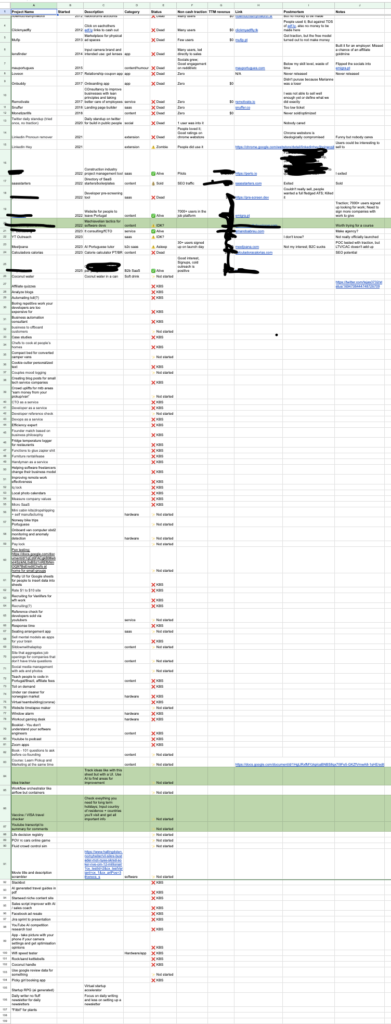
You might be surprised. I have a google sheet where I track everything I’ve thought of. Some get tested, some get killed before testing. It’s 100+ hypothesis.
A single one of these is responsible for 95% of my income.