One of the easiest opportunities to miss is a problem you solve once and immediately forget about.
Years ago, one of my co-founders left a company we had started.
Our Google Workspace account was being paid with a company card in her name, so I needed to replace it with mine.
My card would not work.
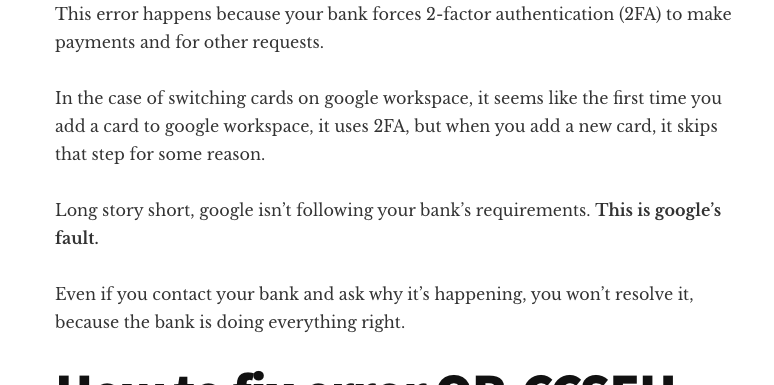
Google gave me an error code. I searched for it and eventually figured out that my card provider expected 3D Secure authentication, but Google was not triggering it at that particular point in the payment flow.
I could not fix Google’s payment system.
So I found a workaround.
I created a virtual card using TransferWise, now Wise, and used that instead.
Problem solved.
For most people, the story would end there.
I had a small technical problem. I Googled it. I figured it out. I moved on.
But I stopped and thought:
If I had to search for this, how many other people are going to search for exactly the same thing?
That was the opportunity.
The Opportunity Was Tiny
This was not some brilliant startup idea.
I did not discover a new market.
I did not build software.
I did not raise money.
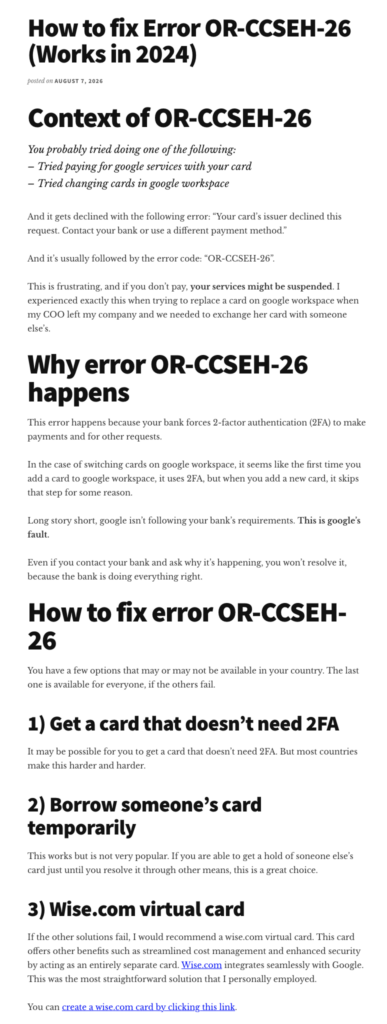
I wrote a short article explaining:
- the error;
- why it appeared;
- and the workaround that had worked for me.
It probably took me only a few minutes to write.
Because people experiencing that exact problem were searching for the exact error, the article started getting found.
I also noticed that TransferWise had an affiliate program, so I used an affiliate link.
If someone solved their problem using my article and became a customer, TransferWise paid me.
The User Journey was:
Experience the problem → Search for the solution → Find my article → Click my affiliate Link → Wise Solves the problem.
That one tiny article eventually generated thousands of dollars.
Was it life-changing money?
No.
But thousands of dollars from a few minutes of work is a difficult return to complain about.
This Is What Spotting Opportunity Often Looks Like
People imagine opportunities arriving as:
“I have invented an amazing business!”
They often look much more boring:
“That was annoying.”
“Why was the answer so hard to find?”
“Surely other people have this problem.”
“Would they search for the same thing?”
“Is someone already paying to reach these people?”
That tiny moment of curiosity can be enough.
The problem does not need to affect millions of people.
It needs to affect enough people, with enough intent, in a way you can reach them.
Someone searching an exact payment error code is very different from someone casually scrolling past a generic advertisement.
They already have a problem.
They are actively looking for a solution.
That makes the distribution valuable.
You Do Not Always Need to Build the Solution
Another useful part of this example is that I did not actually provide the underlying product.
Wise did.
I simply connected:
A person with a problem → useful information → an existing solution
That is essentially what affiliate marketing allows you to do.
A company gives you a percentage or fixed payment for customers you send them.
This can be an excellent way to practise spotting demand and learning distribution because you do not also have to invent, build, and deliver the product.
If you cannot get people to act on a useful product that already exists with optimised value-proposition, funnels, etc. Then I doubt your ability to sell your own product.
But Small Opportunities Change
Eventually, this particular opportunity became much less attractive.
Wise could see the same opportunity.
They began producing much more content themselves around banking problems and error codes, and affiliate programs and commissions can change over time.
That is normal.
You do not own their product or their affiliate rules.
Small opportunities appear.
Small opportunities disappear.
The skill is learning to notice them.
Build the Habit
Whenever you solve an unusual problem, especially one that required searching, experimenting, or combining information from different places, pause before moving on.
Ask:
Was this unusually difficult to figure out?
Are other people likely to have the same problem?
What would they search for?
Can I make the answer easier to find?
Is there already a product or service connected to solving it?
Most of these observations will lead nowhere.
That is fine.
You are training yourself to notice opportunities that other people walk past.
The important part of this story was not TransferWise.
It was the moment between:
“I solved my problem.”
and:
“Wait. Other people probably have this problem too.”
That moment is where a surprising number of opportunities begin.
Even on your current journey, if you don’t think “There has to be an easier way” at least 10 times per day, you’re not paying enough attention.
There are millions of hyper specific problems being encountered every hour, some with enough legs to be a business.